Marguerite de Charny's Custody of the Shroud and Transfer to Savoy (1418-1464)
Geoffroy II de Charny died in 1398 at about 54 years old. His daughter Marguerite de Charny, born between 1385 and 1388, was around 12 at the time of his death. She married Jean de Bandremont in 1400 at around 14, was widowed at Agincourt on October 25, 1415 at around 29, and remarried Humbert de Villersexel in 1418 at around 32.
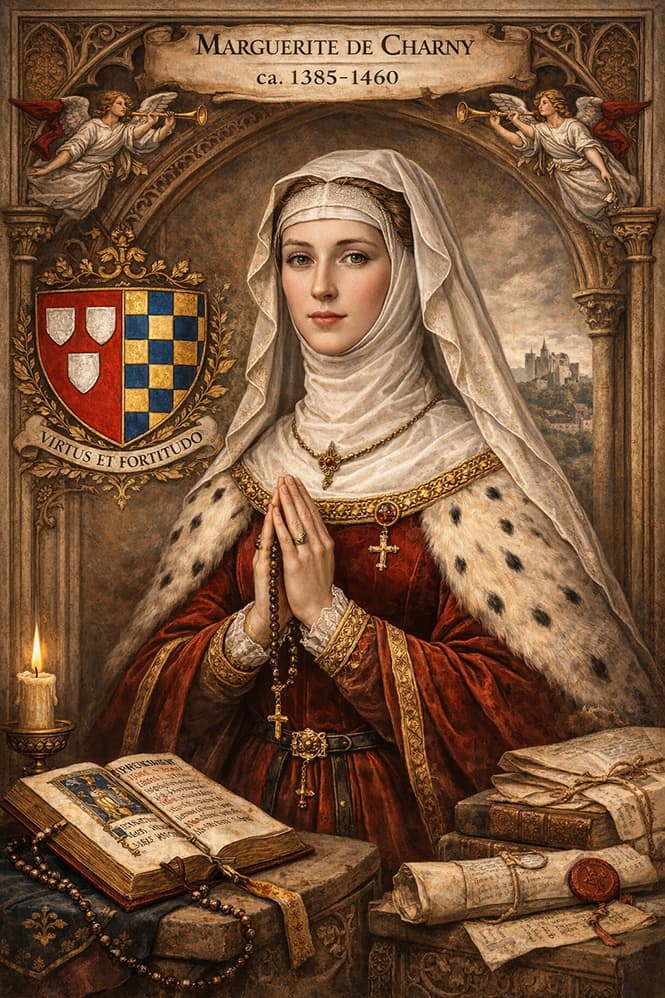
Family Wealth and Estate Background
Before 1398, the Charny family had built a large landed base. Pierre-Perthuis came through Geoffroy I’s first marriage to Jeanne de Toucy, Montfort came through his second marriage to Jeanne de Vergy, and in 1343 the crown assigned him estate revenues to support his foundation at Lirey. The family looked powerful, but part of that wealth was already tied to long-term obligations.
In 1353 Geoffroy I endowed the collegiate church at Lirey with permanent land income for six canons and supporting clergy. After his death at Poitiers in 1356, Jeanne de Vergy secured transfer of the royal income grant to their son Geoffroy II and obtained a royal house in Paris for him while he was still underage. By 1398, when Geoffroy II died, the family still held rank and property, but cash was less flexible than the titles suggested.
After 1398 the estate did not disappear, but control became harder to convert into ready money. Marguerite inherited the Charny position, and her 1400 marriage tied important rights to the Bauffremont network. After her first husband’s death in 1415, claims shifted again among relatives. In 1435 she exchanged major Burgundian properties (Beaumont-sur-Vingeanne, Montfort, Savoisy, Thury, Tonnerre) for Varambon and Bouligneux plus 4,000 gold coins. The contract itself says those Burgundian lands were difficult to manage in a war-damaged zone, and later records indicate the 4,000-coin payment was not fully made. In short, the family still held valuable assets, but reliable income and enforceable control were increasingly unstable.
Wartime Transfer and Long Custody at Saint-Hippolyte (1418-1438)
Through Humbert’s mother, Guillemette de Vergy, Marguerite and Humbert were related. Amid the insecurity of the Hundred Years’ War, the chapter of Lirey removed the Shroud and other valuables from the collegiate church on June 6, 1418 and placed them in Humbert’s care. His receipt described it as “a cloth” stored in a chest bearing the Charny arms. After a period at Montfort, the Shroud was kept at Saint-Hippolyte, where annual Easter public displays were held near the Doubs at Le Pre-du-Seigneur (also called Le Clos-Pascal). The Shroud remained there for nearly thirty years.
Litigation with Lirey (1438-1449)
Humbert died childless in 1438, when Marguerite was around 52. The canons of Lirey then demanded return of the Shroud and the other valuables entrusted in 1418. Their legal position was that this had been emergency safekeeping during wartime, not a transfer of ownership, so the chapter sought full return plus compensation for lost pilgrimage donations while the Shroud stayed away from Lirey.
On May 8-9, 1443, when Marguerite was around 57, the parliament of Dole ordered return of several objects but let her keep custody of the Shroud for three more years, on condition that she compensate the chapter for those lost donations. She never paid that compensation. She then obtained two more three-year delays, in 1446 and 1449, including a promise to fortify the church precinct at Lirey. Her argument did not change: the Shroud belonged to the Charny family and had only been deposited with the canons.
Traveling Exhibitions (1449-1453)
By the late 1440s, when Marguerite was around 63, she was carrying the Shroud across a broader courtly and political circuit. In 1449 she exhibited it at Chimay in Hainaut, placing it in the castle chapel. A Benedictine monk from the Abbey of Saint-Jacques in Liege attended and left a vivid description of what he saw.
The Chimay display triggered a formal church inquiry. Jean de Heinsberg, prince-bishop of Liege, sent two theologians to investigate. They required Marguerite to produce authorization linked to Clement VII and to state publicly that the object shown was a representation, not the burial Shroud itself. After their report, the prince-bishop banned further display in his diocese and expelled Marguerite.
She then moved through Burgundian territory, including Mons, which had been under Duke Philip the Good as Count of Hainaut since 1433. In 1452, at around 66, she stayed about a week at the Chateau de Germolles near Beaune and organized public showings on September 13 and 14. During Lent 1453, around age 67, she was in Geneva while Duke Louis of Savoy and Duchess Anne of Cyprus were in residence. Three public exhibitions are recorded there: Plainpalais on February 26, Rive before March 20, and the private chapel of Jean de Rolle on March 25.
These traveling exhibitions intensified her conflict with Lirey and with regional church authorities, and the dispute later culminated in her excommunication in 1457.
Savoy Settlement and Financial Terms (1453-1455)
By the time Marguerite left Geneva, custody had shifted to Duke Louis of Savoy. Acts dated March 22 and March 29, 1453, when she was around 67, granted her lifetime use of the castle, town, and castellany (administrative district) of Miribel. In 1455, around age 69, Miribel was replaced by the castle and castellany of Flumet as frontier policy changed.
The documents do not name the Shroud directly, consistent with church rules against open relic sales, and present the arrangement as grants for services. Even so, the financial structure is clear. Documentary reconstruction indicates that Duke Louis took over the still-unpaid 4,000-gold-coin obligation from Marguerite’s earlier settlement with Francois de La Palud, then added annual pensions of 100 gold florins from Montluel revenues and 1,000 gold florins from Chateauneuf-en-Valromey, plus a grant of 10,000 gold coins. These are medieval coin values and cannot be converted cleanly into modern euros, but they represent substantial purchasing power. Parts of this package were later revised during the political crisis of 1454-1455.
Sanctions, Settlement, and Closure (1457-1464)
The canons of Lirey challenged the Savoy transfer before the archiepiscopal court of Besancon. Marguerite was excommunicated on May 30, 1457, when she was around 71; the sentence was later lifted after payment. The historical record is not uniform on her death date: one reconstruction gives October 7, 1459, while another gives October 7, 1460. In either case, she died in her early seventies. No surviving act in the core document set securely identifies the place of her death. On February 6, 1464, a Paris agreement granted Lirey an annual pension from Gaillard revenues, and the canons recognized Savoy’s lawful possession of the Shroud. This is the first known Savoy document to mention the Shroud.
Historical Significance
Taken together, these records show more than a devotional itinerary. They connect inheritance pressure, court disputes over pilgrimage donations, and negotiated pensions to the final transfer of the Shroud from the Charny line to the House of Savoy.
Sources & References
- Francois-Xavier de Villemagne, 'Le Saint Suaire de Lirey au duc de Savoie (1418-1464)', Revue de l'Academie salesienne 26. View source →
- BSTS Newsletter No. 38, Part 6, 'A Chronology of the Shroud 1452-1509.' View source →
- Shroud News No. 88, Part 3, Ian Wilson, 'Shroud Acquired by Duke Louis of Savoy in 1453: The Documentary Evidence.' View source →
- Andrea Nicolotti, 'The Veil of the Goddess: The Alleged Travels of the Shroud to the East,' pages 97-98 (Oxford University Press, 2020). View source →