STURP Scientific Examination
From October 8-13, 1978, a team of American scientists known as the Shroud of Turin Research Project (STURP) conducted an unprecedented examination of the Shroud. This marked the first time modern scientific equipment was allowed direct access to the Shroud.
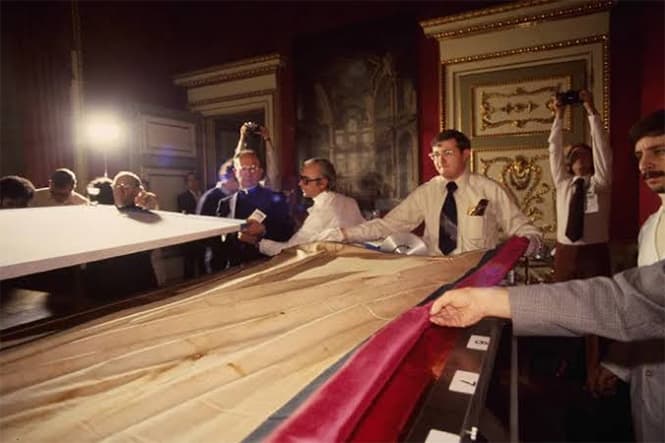
The STURP Team
STURP consisted of approximately 40 scientists from various disciplines:
- Physicists
- Chemists
- Photographers
- Forensic experts
- X-ray specialists
- Spectroscopists
The team included researchers from prestigious institutions and laboratories, including Los Alamos National Laboratory, the Jet Propulsion Laboratory, and several universities.
Equipment and Methods
The team brought over 70 pieces of scientific equipment weighing several tons to Turin. Their investigation employed:
- X-ray fluorescence to analyze elemental composition
- Reflectance spectroscopy to study the image formation
- Infrared thermography to detect subsurface features
- Ultraviolet photography to reveal fluorescent properties
- Microscopic examination of fibers and image areas
- Chemical tests on sticky tape samples taken from the Shroud
Key Findings
After three years of analysis, STURP published several significant findings:
The Image
- The image is not painted: no pigments, dyes, or stains were found that could account for the image
- The coloration resides only in the topmost fibers, with no capillary action into the weave
- The image appears to be the result of oxidation and dehydration of the Shroud’s cellulose fibers
- The image encodes three-dimensional information
The Blood
- The stains tested positive for blood using multiple independent tests
- The blood appears to be real human blood, type AB
- The blood chemistry suggests genuine wound trauma
What It Isn’t
The team conclusively ruled out several image-formation hypotheses:
- Not painted with pigments
- Not created by dyes or stains
- Not formed by applied heat or scorch marks
- Not the result of any known artistic technique
Unresolved Questions
Despite the extensive investigation, STURP could not determine how the image was formed. Their final report stated: “We can conclude for now that the Shroud image is that of a real human form of a scourged, crucified man. It is not the product of an artist.”
Impact
The STURP investigation established baseline scientific data that continues to be analyzed and debated. It demonstrated that serious scientific study of the Shroud was both possible and necessary, setting the standard for future investigations.
Many of the original STURP findings remain unexplained and continue to challenge current scientific understanding of image formation on ancient textiles.
Sources & References
- Schwalbe, L. & Rogers, R. (1982). Physics and Chemistry of the Shroud of Turin: A Summary of the 1978 Investigation. Analytica Chimica Acta, 135(1), 3-49.
- Heller, J. & Adler, A. (1980). Blood on the Shroud of Turin. Applied Optics, 19(16), 2742-2744.
- Jackson, J., Jumper, E., & Ercoline, W. (1984). Correlation of image intensity on the Turin Shroud with the 3-D structure of a human body shape. Applied Optics, 23(14), 2244-2270.