First Documented Appearance in Lirey
The relic later known as the Shroud of Turin first enters the historical record at Lirey, Champagne, France, on June 5, 1357, when bishops granted indulgences for pilgrims visiting its public display.
Lirey is a village in Champagne, about 20 km (12 miles) south of Troyes. The medieval collegiate church (a church run by a resident group of canons) was destroyed after the French Revolution and replaced by the current parish church in 1897.
Background (before 1340 to 1356)

Geoffroy de Charny, lord of Lirey and a leading knight close to the French crown, built the church structure in which the shroud would later be shown.
- Before 1340: Geoffroy first married Jeanne de Toucy. Through that marriage, he gained the chateau of Pierre-Perthuis.
- 1340: After Toucy’s death, Geoffroy married Jeanne de Vergy. Through that marriage, he gained the chateau of Montfort. They later had two children, Geoffroy II and Charlotte.
- 1343: King Philippe VI granted Geoffroy income from a specific piece of land to help fund the church at Lirey. This was targeted funding, not all local income. The king also donated relics, but no shroud is mentioned.
- 1343-1344: Geoffroy got permission to build from the abbey of Montier-la-Celle in exchange for about four acres of hay/pasture land and a yearly payment (six livres). The church was built of wood, following local building practice.
- April 16, 1349: Geoffroy asked Pope Clement VI to raise the church’s status and grant 100 days of indulgence to visitors, helping make Lirey more attractive as a pilgrimage destination.
- June 20, 1353: Geoffroy signed the formal foundation deed before a notary and witnesses. He funded six salaried canons plus supporting church staff with permanent land revenue.
- October 1, 1353: King Jean II (Jean le Bon) confirmed the foundation.
- Early 1354: Pope Innocent VI issued papal letters (“bulls”) granting key rights: a cemetery, family influence over church appointments (with bishop approval), and 40 days of indulgence for visitors.
- October 16, 1354: The canons of Lirey held their first recorded assembly.
- May 28, 1356: Bishop Henri de Poitiers approved the foundation.
These documents show a functioning and funded church institution before 1357, with established religious privileges and administration. They do not mention a shroud.
Family and power network around Lirey
The Lirey project sat at the intersection of religion, money, and political influence.
- Geoffroy served the kings of France as counselor, diplomat, and military commander.
- Through Jeanne de Vergy, the project was tied into a wider aristocratic family network.
- On the Vergy side, the tie predates the shroud exhibitions by decades: Louis de Poitiers (Henri’s brother) and Marguerite de Vergy signed marriage contracts dated May 20, 1319 and July 23, 1321 (Paris).
- After Geoffroy’s death at Poitiers on September 19, 1356, Jeanne de Vergy secured transfer of his income rights to their son Geoffroy II (then about twelve), and the king provided additional support in Paris.
- Jeanne de Vergy (Geoffroy I’s widow, Geoffroy II’s mother): She remarried in June 1361 to Aimon de Geneve (seigneur d’Anthon et de Varey), making Cardinal Robert de Geneve her cousin by marriage; he later became Pope Clement VII (1378).
- On the Charny side, a later link followed: Geoffroy II de Charny (the son of Geoffroy de Charny and Jeanne de Vergy) married Henri’s niece, Marguerite de Poitiers.
This helps explain why Lirey could keep operating after Geoffroy’s death, with family and institutional responsibilities managed for a minor heir. It also matters for the later dispute: Henri de Poitiers was already tied to the Vergy network before 1357, and in 1389 Pierre d’Arcis claimed that Henri had earlier investigated the Shroud.
First documented exhibition of the shroud (1357)
In 1357, Jeanne de Vergy organized public showings of the shroud at Lirey. This is the first securely dated appearance of the object in history.
On June 5, 1357, twelve bishops granted indulgences to pilgrims traveling to Lirey. By then, the church already had:
- Funded clergy and regular administration
- Established pilgrimage incentives, including indulgences
- Noble patronage and royal protection
In practice, devotion and the local economy were tightly linked: more pilgrims meant more offerings, more prestige, and more demand for devotional objects. For Jeanne, as guardian of her son’s interests, that likely had practical value as well as devotional meaning.
Physical evidence of pilgrimage activity
The Cluny badge (found 1855)
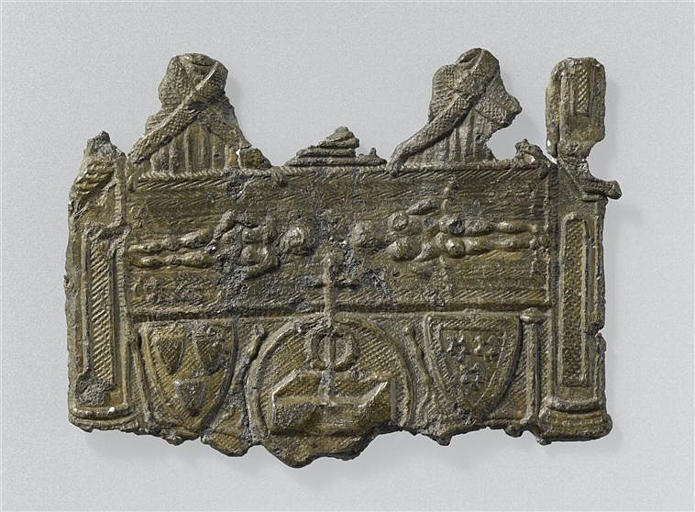
A pewter pilgrimage badge found in Paris in 1855 (near Pont au Change), now in the Musee de Cluny, shows imagery tied to Lirey:
- Full-body image shown front and back
- Hands crossed over the lower body
- The Shroud’s herringbone weave
- Arms of Charny and Vergy displayed beneath the shroud
The Machy mold (found 2009)
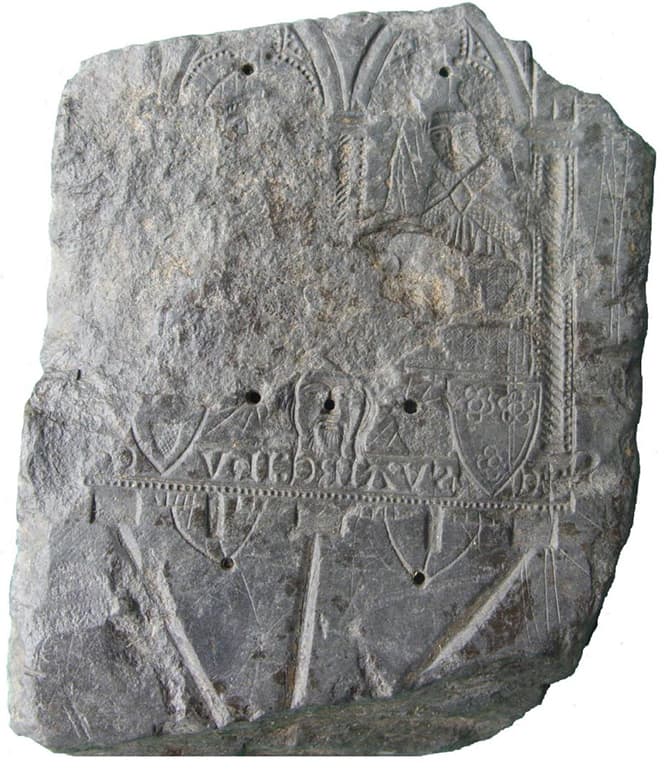
In 2009, a stone mold used to make similar badges was found near Machy, south of Lirey. Its design shows two likely clergy figures holding up the Shroud and includes a reverse inscription with the French word “suaire” (“shroud”).
Taken together, the badge and mold show that Lirey’s exhibition activity was organized and repeated, not a one-time event.
For what happened next, see the 1389 d’Arcis memorandum and the 1390 bull of Clement VII.
Why this matters
Lirey in 1357 matters for two reasons:
- It is the first clear documentary appearance of the shroud.
- It appears inside a system already built between 1343 and 1356 through land income, church privileges, indulgence-based pilgrimage incentives, and powerful family alliances.
That combination helps explain why the object quickly became both a major focus of devotion and a major source of dispute.
Sources & References
- Regat, C. (2015). History of the Holy Shroud. Académie salesienne, November 9, 2015. View source →
- Chevalier, U. (1903). Autour des origines du suaire de Lirey. Includes d'Arcis memorandum and Clement VII texts. View source →
- Nicolotti, A. (2020). The Shroud of Turin: The History and Legends of the World's Most Famous Relic. View source →
- Cawley, C., Medieval Lands (as cited in WeRelate family entry for Louis de Poitiers and Marguerite de Vergy), listing marriage contract dates. View source →